
From Screen to Field: Validating AI Targets in Sierra Leone
Oct 20, 2026 · MineTech
Lithium exploration still depends on field mapping, sampling, trenching and drilling. Our strategy is to make those activities more focused by using artificial intelligence as a first-pass screening system. Geological maps, satellite imagery, structural features, geophysical information and available geochemical evidence are combined to rank locations for investigation.
The model is no longer theoretical. AI-generated Priority Targets and Confidence Points are actively guiding fieldwork. Geologists are visiting these locations, recording observations, carrying out pitting and trenching where justified, and collecting samples for further evaluation. Every visit, whether positive, negative or inconclusive, adds evidence that can improve the next model cycle.
AI identifies where to investigate
Our model does not claim to detect lithium directly or to replace geological judgement. It searches for combinations of conditions associated with hard-rock lithium systems: suitable granitic host rocks, pegmatitic environments, faults and shear zones, alteration signatures, and supporting radiometric or geochemical anomalies. The result is a ranked prospectivity view that helps the team decide where to investigate first.
Moving the model from the screen to the field
Recent ground-truthing in Sierra Leone tested this approach under real operating conditions. Targets that appeared close on a map often required long journeys through dense vegetation, mud, streams and steep ground. At each location, the geologist assessed the wider surroundings, not only the GPS point, before recommending mapping, pitting, sampling or trenching. This disciplined sequence keeps each decision evidence-based while directing resources towards the most promising work.
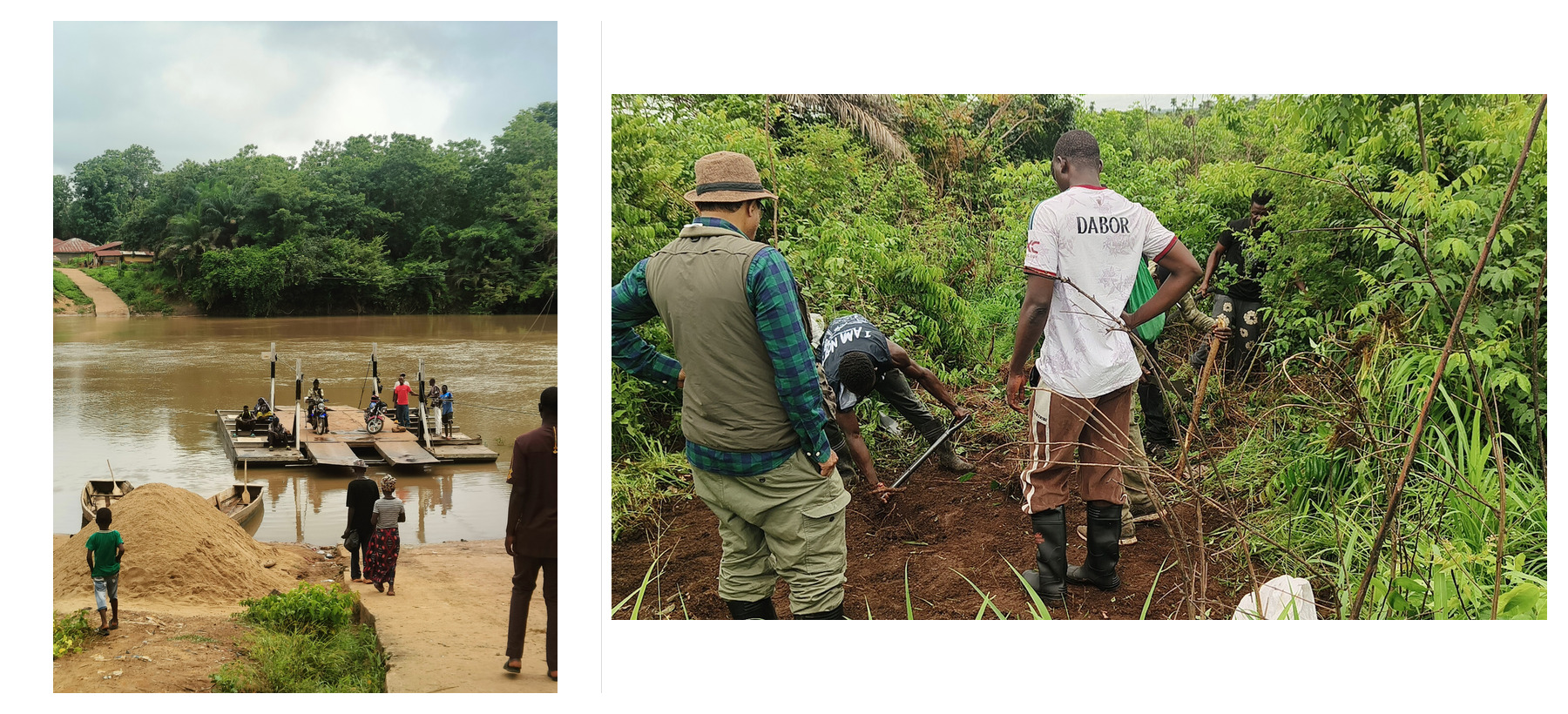
From prediction to field validation: difficult access conditions and ground reconnaissance at AI-generated targets in Sierra Leone. Source: Sierra Leone fieldwork team.
What the field is teaching us
Area 7 showed why a confidence point should not be treated as one exact pin. Some coordinates initially exposed only laterite, yet nearby investigation identified weathered pegmatite and pegmatite outcrops. Vegetation, soil cover, weathering and satellite resolution can shift the visible surface expression away from the predicted point. We are therefore refining targets as search zones, with investigation radii that reflect data resolution and spatial confidence.
Area 6 demonstrated the value of structured follow-up. Encouraging surface observations led to trenching, which exposed pegmatite wider than its initial surface expression. Additional trenches helped assess continuity, and samples were collected for evaluation. These observations do not by themselves confirm an economic lithium resource, but they show how an AI-prioritised target can support a logical progression from digital screening to field investigation.
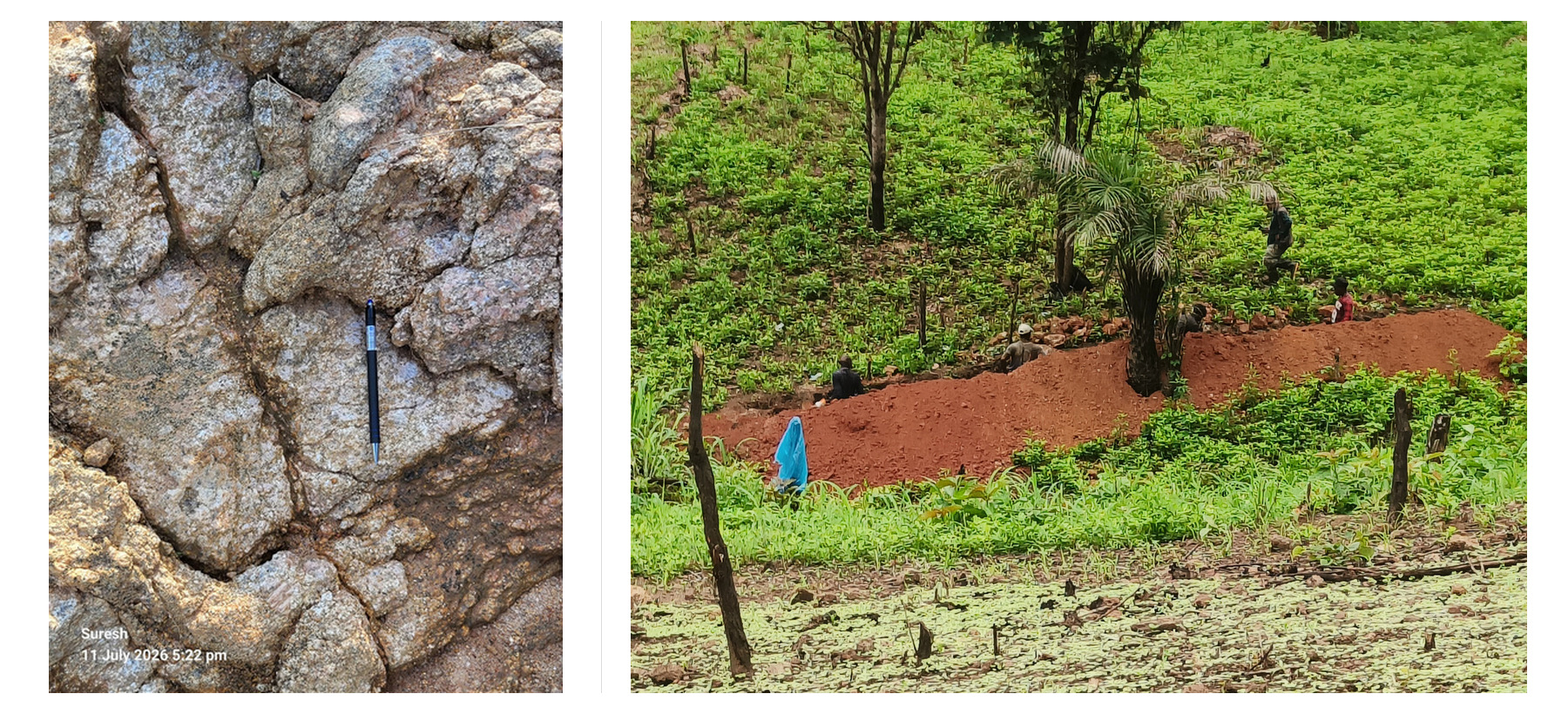
Field evidence informing the model: an exposed pegmatitic rock body and trenching used to assess geological width and continuity. Source: Sierra Leone fieldwork team.
Turning field evidence into better predictions
We are using field observations to adjust the weighting of geological, structural, spectral and radiometric indicators, to improve spatial confidence, and to distinguish geological potential from operational accessibility. Future target outputs should also explain why a hotspot was generated, such as proximity to a structural intersection, an alteration signature or supporting radiometric evidence.
The platform will increasingly connect predictions with GPS tracks, photographs, accessibility notes, pit and trench records, geological interpretations and laboratory results. This creates a continuous learning cycle: AI prioritises targets, geologists validate them, field evidence is captured, and future recommendations become better informed.
Our goal is not to present AI as a finished answer. It is to build a transparent, field-tested exploration system in which technology and geological expertise continuously strengthen one another.
This content is for informational purposes only and does not constitute investment advice.